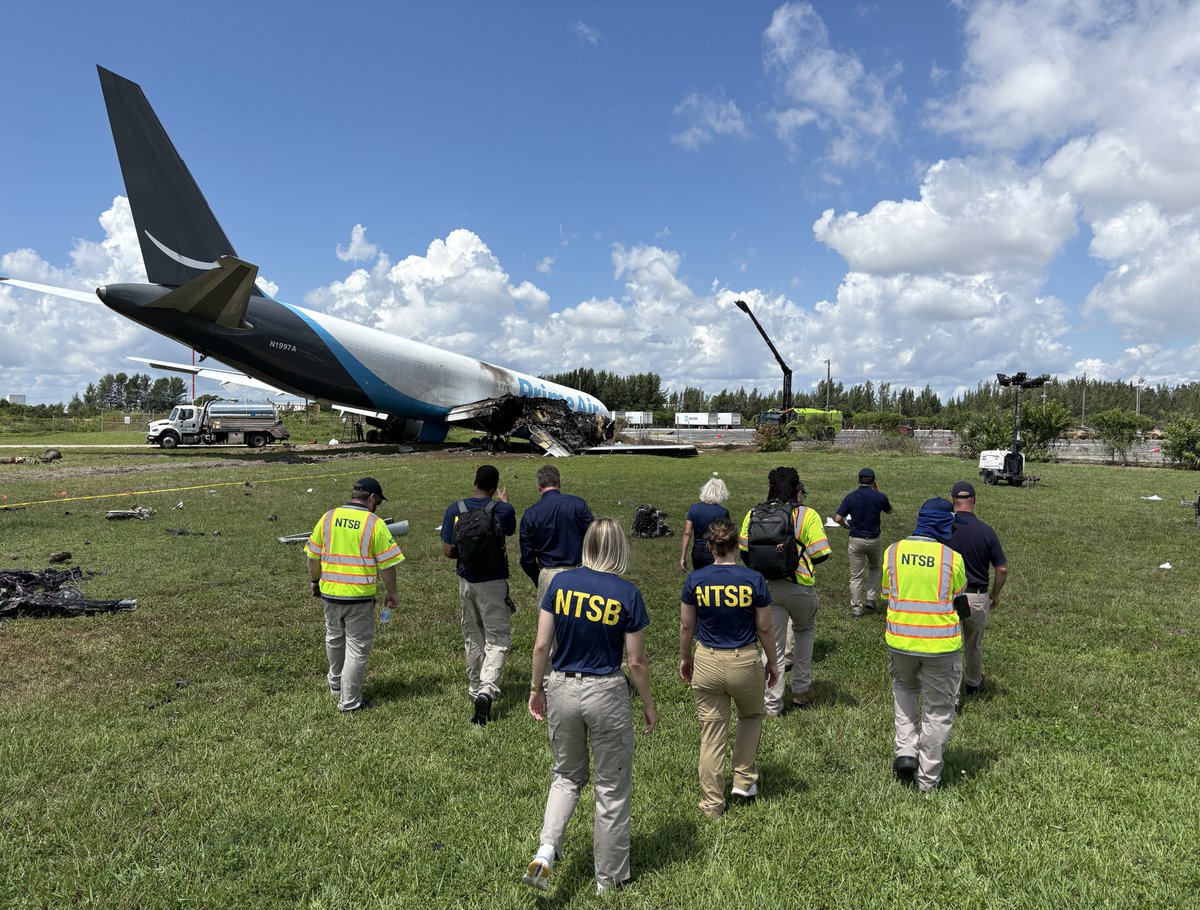
An air traffic controller cleared an Amazon cargo plane for landing in Miami but did not provide wind information when issuing the landing clearance, a federal preliminary report found.
The National Transportation Safety Board (NTSB) released the report Thursday, Oct. 1, detailing new findings in the Sept. 6 crash of Flight 7598, a Boeing 767 freighter. The plane had departed Amazon's air hub in Hebron that morning, flown to Miami and then San Juan, Puerto Rico. The crash occurred on the return leg to Miami, when the aircraft overran the runway at Miami International Airport and killed five people on the ground.
Four minutes before clearing Flight 7598, the controller had warned a different aircraft about winds from the south at 19 knots with gusts to 22 knots, Spectrum News 1 reported. Flight 7598 was not on the controller's radio frequency at the time. Federal regulations require controllers to state both wind direction and velocity when authorizing runway use with a tailwind component.
"When you've got winds like that, it is your responsibility as a controller to issue that to a pilot, especially on landing and especially when you have gusts," said Tony Mello, a former Federal Aviation Administration (FAA) official who oversaw air traffic control services in the central U.S.
The wind-warning failure is one of several factors the NTSB documented. The report also found that the plane's speed brakes remained stowed and its thrust reversers never deployed during landing, as we reported Sept. 8. Cockpit recordings showed one pilot repeatedly warning the other about speed, but the second pilot never gave a consistent verbal response, according to the NTSB. The two pilots had flown together for the first time that day.
The plane crossed the runway threshold at roughly 203 mph and touched down about 3,750 feet beyond it, USA Today reported. Data from the flight recorder showed the pilots may have attempted a late go-around: wheel brakes were applied, then released as engines throttled up, before brakes were reapplied with only about 415 feet of runway left. The plane left the pavement at 130 mph.
The 767 barreled roughly 1,200 feet past the runway's end, striking a van carrying airplane cleaning workers. Five people in the van died. Two others in the van and the driver of a car hit by the plane sustained serious injuries. Both pilots had minor injuries.
Former NTSB member John Goglia called the missing wind advisory a significant omission but said it alone would not have caused a crash. He said every crash involves a chain of events.
Flight 7598 was operated by 21 Air LLC, a Greensboro, North Carolina-based cargo carrier that began flying Boeing 767-300 freighters for Amazon in 2024. Amazon does not hold its own FAA air carrier certificate; contracted carriers fly its routes. Amazon suspended its use of 21 Air after the crash, according to NBC News.
Amazon Air's $1.5 billion CVG superhub in Hebron supports more than 4,000 jobs and handles more than three dozen daily cargo flights. The NTSB investigation is examining 21 Air's policies, pilot training, the contractual relationship with Amazon, FAA oversight and weather conditions.
A final NTSB report could take more than a year. Families of the victims have filed lawsuits alleging negligence by the pilots, 21 Air and Amazon.