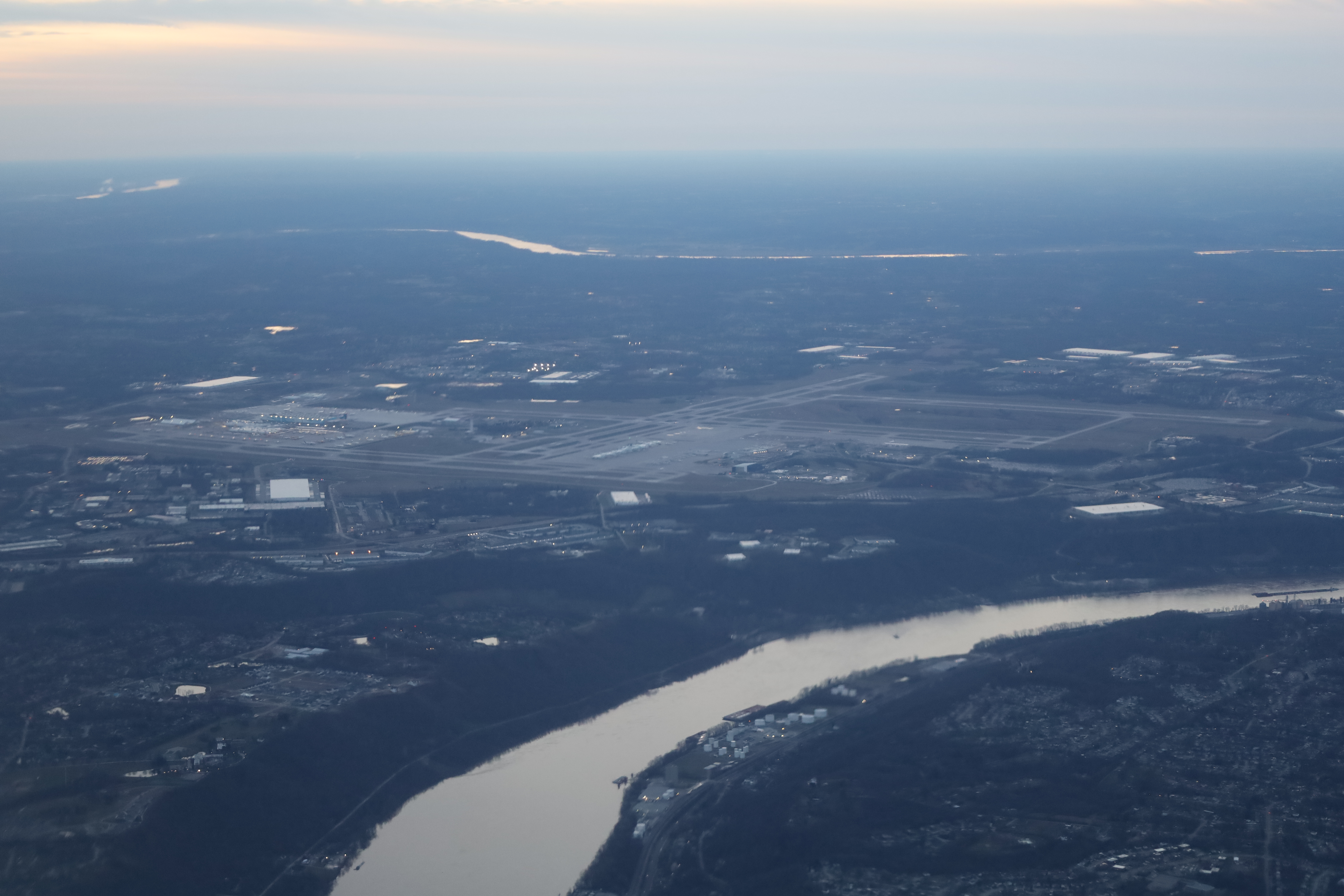
Boone County's logistics hubs, airport employers, and advanced manufacturers can't find enough local workers to fill open positions, forcing them to recruit across the Ohio River from Cincinnati.
That's the picture painted by BE NKY's 2025 Economy in Review, which finds Northern Kentucky adds just one new worker for every two residents gained. The region's labor force stands at roughly 217,000 workers with a 66% participation rate that tops both state and national averages, according to the report. But it's not enough.
"You see a lot in the skilled labor around the airport, advanced manufacturing, logistics and transportation industries, there just simply aren't enough people who want to work those jobs, who live in Boone County or who live in Kenton County," Ashby Drummond, research analyst at BE NKY, said. "So they have to import that labor from primarily across the river."
The report identifies three structural causes: a rapidly aging population, slowing birth rates, and limited in-migration. Twenty-three percent of Northern Kentucky's population is now over 60, up from 18% in 2014.
Demand keeps growing
Even as the worker pipeline tightens, employers keep expanding. In 2025, BE NKY announced 15 project wins totaling $425.5 million in capital investment and 1,914 new jobs across Boone, Kenton, and Campbell counties, according to the organization's annual report.
Several of those projects landed squarely in Boone County: Jabil announced a $105 million expansion creating 900 jobs, Stord committed to a $40-plus million warehouse in Hebron with more than 500 positions, and L2 Aviation opened a $12.2 million facility with 250 jobs.
Transportation and warehousing remains the region's most concentrated sector, with a location quotient of 3.34. The sector added 19,000 jobs since 2014, a 130% increase, but generates the lowest value per worker among traded industries at $96,760 annually, compared to a $123,198 U.S. average, according to the BE NKY report.
DHL's North American superhub and CVG anchor that logistics cluster. Manufacturing employs 22,855 workers regionally, generates $4.3 billion in gross regional product, and pays an average annual wage of $80,475.
Regional leaders sound the alarm
Correy Eimer, workforce development director at the Northern Kentucky Area Development District, said the math doesn't add up. The population growth projected for the region won't be enough to fill all the available jobs, Eimer said.
Nancy A. Spivey, vice president of talent strategies at the NKY Chamber of Commerce, noted the region's 66% participation rate shows residents aren't sitting on the sidelines. The challenge is volume, not willingness.
In an April 2026 interview with LINK nky, BE NKY CEO Lee Crume said the region needs to shift its focus toward boosting productivity per worker, calling it "really, really important" even as attracting new residents becomes harder.
What comes next
BE NKY's report outlines five priorities: building a future-ready workforce, investing in build-ready sites and infrastructure, advancing housing affordability, accelerating the life sciences cluster, and elevating manufacturing toward higher-value production. No public timeline has been set for implementing the full framework.
The housing piece matters locally. Housing costs in Northern Kentucky have risen 104% to 150% since 2000, far outpacing the 81% increase in the Consumer Price Index, according to the report. BE NKY says affordability gaps are limiting the region's ability to attract and retain workers.
In May 2025, BE NKY invested $440,000 into three education nonprofits, Adopt A Class, TradesNKY, and Learning Grove's NaviGo College and Career Prep, to build the skilled-trades pipeline for K-12 students in the region.